What does the Elizabeth name truly mean — and why does it carry such extraordinary spiritual weight? If you have ever asked this question, you are in the right place.
The Elizabeth name is not just one of the most beloved Christian girl names in history.
It is a name anchored in a real biblical woman whose life became a living testimony of God’s faithfulness, answered prayer, and promises fulfilled against all odds.
Whether you are a parent choosing a name for your daughter, a woman named Elizabeth seeking her spiritual identity, or a believer drawn to the depth of biblical names — this guide will walk you through everything you need to know.
What Does the Name Elizabeth Mean in the Bible?

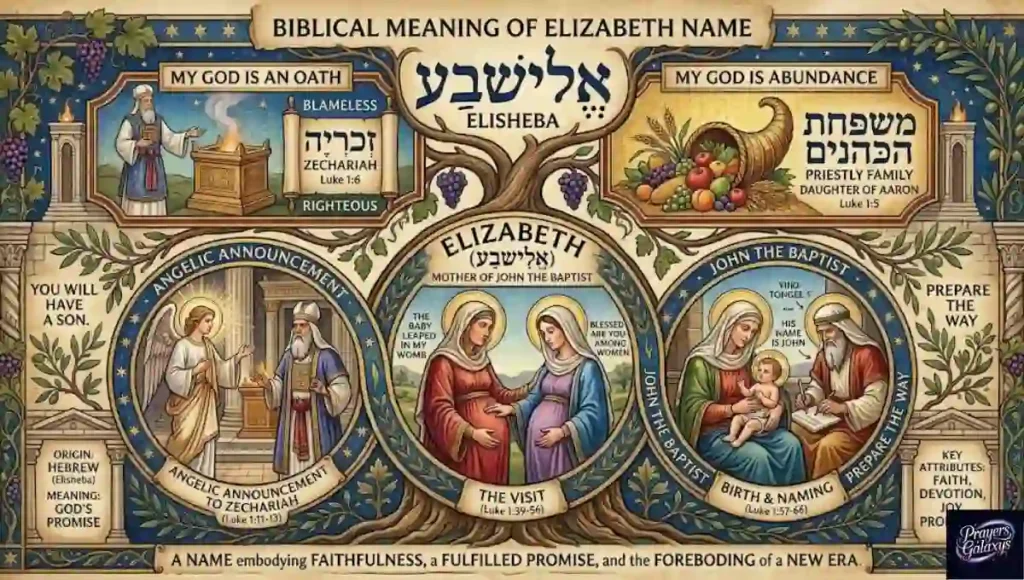
The Elizabeth name comes directly from the Hebrew name Elisheba (אֱלִישֶׁבַע), which is composed of two powerful Hebrew elements:
- El (אֵל) — meaning “God”
- Sheba / Sheva (שֶׁבַע) — meaning “oath,” “seven,” or “abundance”
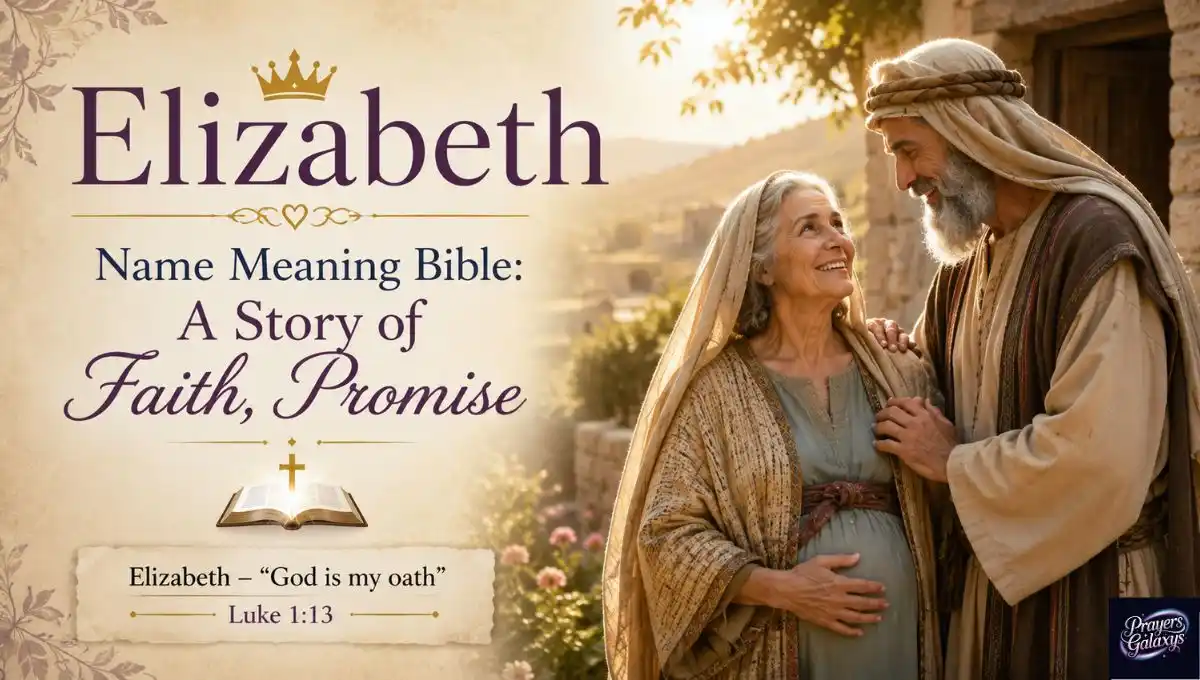
Together, the Elizabeth name translates to “God is my oath,” “My God is abundance,” or “pledged to God.” In Hebrew theology, an oath is the most sacred form of commitment — an unbreakable promise. When the Elizabeth name declares “God is my oath,” it is saying that God Himself is the foundation of every promise made, every hope held, and every prayer whispered.
The number seven in Hebrew carries profound significance — representing completeness, wholeness, and divine perfection. The Elizabeth name meaning therefore holds a double truth: God’s covenant is complete, and His promises never fail.
Must Read : Kimberly Name Meaning in Bible: Faith, Purpose & Divine Protection
Is Elizabeth a Biblical Name?
Yes — absolutely and without question. The Elizabeth name is one of the most directly biblical feminine names in existence. It appears in two distinct places in Scripture:
In the Old Testament: The name appears as Elisheba — the wife of Aaron (brother of Moses). Exodus 6:23 records: “Aaron married Elisheba, daughter of Amminadab and sister of Nahshon.” As the wife of Israel’s first High Priest and the mother of all the Levitical priests, Elisheba holds a foundational place in biblical history.
In the New Testament: The name appears as Elizabeth — the wife of Zechariah, a descendant of Aaron, and the mother of John the Baptist. She is mentioned nine times in the Gospel of Luke and is described as righteous, blameless, and filled with the Holy Spirit.
The Elizabeth name is not borrowed from culture — it was born in Scripture.
Elizabeth in the Bible: Meaning and Story
The story of the Elizabeth name in the New Testament is one of the most moving accounts of faith, waiting, and divine fulfillment in all of Scripture. It is found entirely in Luke chapter 1.
Who was Elizabeth in the Bible?
- She was the wife of Zechariah, a priest of the division of Abijah
- She was a descendant of Aaron — meaning she came from Israel’s priestly lineage
- She was the cousin of Mary, the mother of Jesus (Luke 1:36)
- She was barren and well advanced in years — unable to have children (Luke 1:7)
- She was described as “righteous before God, walking blamelessly in all the commandments and ordinances of the Lord” (Luke 1:6)
The miracle of Elizabeth:
The angel Gabriel appeared to Zechariah in the temple and announced the impossible: “Do not be afraid, Zechariah; your prayer has been heard. Your wife Elizabeth will bear you a son, and you are to call him John” (Luke 1:13). Zechariah doubted — and was struck mute until the promise was fulfilled. Elizabeth, however, received the news in her heart with faith and deep gratitude.
When Mary came to visit Elizabeth, the baby in Elizabeth’s womb leaped for joy at the sound of Mary’s greeting — John the Baptist recognizing Jesus while both were still unborn.
Filled with the Holy Spirit, Elizabeth cried out in a loud voice: “Blessed are you among women, and blessed is the child you will bear! But why am I so favored, that the mother of my Lord should come to me?” (Luke 1:42-43).
Remarkably, Elizabeth was the first person in the Gospel of Luke to call Jesus “Lord” — a profound theological declaration spoken by a woman of faith, filled with the Spirit.
When John was born, Elizabeth stood firm against cultural pressure to name him after his father, declaring boldly: “No! He is to be called John” (Luke 1:60). Her obedience was complete and immediate.
The Elizabeth name in the Bible carries the story of every person who has waited on God, doubted their own worth, and then witnessed God’s promise fulfilled in a way more beautiful than they ever imagined.
Biblical Meaning of the Name Elizabeth
The biblical meaning of Elizabeth rests on three unshakeable pillars:
1. God Keeps His Covenant An oath in biblical culture was a binding, sacred commitment. The Elizabeth name meaning — “God is my oath” — declares that God’s covenant is the most trustworthy thing in all of existence. What He promises, He delivers.
2. God Sees the Faithful Heart Elizabeth was barren but blameless. She did not allow her unanswered prayers to poison her devotion. The biblical meaning of Elizabeth affirms that God sees faithfulness even in seasons of apparent silence.
3. God’s Timing is Perfect Elizabeth conceived in old age — when human possibility had long expired. The Elizabeth name forever speaks to the truth of Ecclesiastes 3:11: “He has made everything beautiful in its time.”
Spiritual Meaning of the Name Elizabeth
The spiritual meaning of the name Elizabeth is as rich as its biblical roots. Spiritually, this name carries:
- Faithfulness — the calling to remain devoted even in seasons of waiting
- Hope — the anchor of a soul that trusts God’s promises over present circumstances
- Covenant identity — a reminder that God’s relationship with His people is sealed by oath
- Prophetic significance — Elizabeth’s womb carried the forerunner of the Messiah
- Spiritual discernment — she recognized Jesus as Lord before anyone else declared it
The Elizabeth spiritual meaning is not passive — it is an active, courageous walk with a God whose promises are always worth waiting for.
What Does the Name Elizabeth Mean Spiritually?
What does the name Elizabeth mean spiritually? It means this: God has made a promise to you, and He will keep it.
Every woman who carries the Elizabeth name is spiritually called to:
- Trust God’s timing even when the answer seems impossible
- Remain righteous in the waiting — blameless before God like Elizabeth of Luke 1
- Receive God’s gifts with humility and gratitude
- Speak boldly what God has revealed — as Elizabeth declared Jesus as Lord
- Stand firm in obedience even against cultural pressure
The Elizabeth name is a spiritual identity — not just a personal one.
Spiritual Meaning of Elizabeth in Hebrew
The Elizabeth name meaning in Hebrew goes deeper than most English-speaking believers realize. The Hebrew root Elisheba is called a theophoric name — meaning it contains the name of God (El) as a foundational element. These were the most sacred types of names in ancient Israel.
Key Hebrew spiritual connections:
| Hebrew Word | Meaning | Spiritual Relevance to Elizabeth |
| El (אֵל) | God | The name begins with God — He is the source |
| Sheva (שֶׁבַע) | Oath / Seven | God’s unbreakable covenant; divine completeness |
| Shavah (שָׁבַע) | To swear / bind with an oath | God bound Himself to His promises for Elizabeth |
| Shalom (שָׁלוֹם) | Peace / completeness | The fruit of trusting God’s covenant |
The Elizabeth Hebrew meaning is a declaration: “I am bound to God, and God is bound to me.” That is the most powerful spiritual identity any name can carry.
Elizabeth Name Meaning in the New Testament
In the New Testament, the Elizabeth name appears in its Greek form — Elisábet (Ἐλισάβετ) — which is the direct Greek transliteration of the Hebrew Elisheba. The Gospel of Luke, written by a Greek physician who emphasized careful historical research, records Elizabeth’s story with extraordinary detail and tenderness.
Elizabeth in the New Testament embodies:
- Righteous living in a corrupt era — both she and Zechariah are described as blameless under Herod’s reign
- Answered prayer after long waiting — her barrenness becoming a miraculous birth
- The first prophetic declaration about Jesus — calling Him “my Lord” before any formal ministry began
- A model for Christian motherhood — raising John the Baptist to fulfill his divine calling
The Elizabeth name meaning in New Testament context is inseparable from the story of salvation itself — she was the hinge between the old covenant and the new.
Elizabeth Name Meaning (Non-Religious)
Outside of religious context, the Elizabeth name carries equally strong associations:
- Royalty and nobility — Elizabeth I and Elizabeth II of England are among the most celebrated monarchs in world history
- Elegance and timelessness — consistently ranking among the top baby girl names globally for centuries
- Literary strength — Elizabeth Bennet of Jane Austen’s Pride and Prejudice is one of literature’s most beloved heroines
- Leadership and confidence — the Elizabeth name in secular culture represents intelligence, poise, and quiet authority
According to Social Security Administration data, the Elizabeth name ranked 15th in the US in 2025, with approximately 6,964 babies per million female births carrying this name — a testament to its enduring appeal across generations.
Elizabeth Name Personality Traits
People named Elizabeth are often described with these characteristics — many of which align with the biblical Elizabeth’s own character:
- Faithful and devoted — steady in commitments, reliable in relationships
- Patient and persevering — able to endure difficult seasons without losing hope
- Spiritually discerning — sensitive to God’s presence and movement
- Quietly strong — they lead through character, not volume
- Compassionate and encouraging — like Elizabeth who strengthened Mary’s faith
- Obedient in conviction — they stand firm even when opposed, as Elizabeth did at John’s naming
The Elizabeth name personality is a portrait of Proverbs 31 — a woman clothed in strength and dignity, who fears God and serves others.
Elizabeth Name Meaning in Islam
The Elizabeth name holds honored status in Islamic tradition as well. Elizabeth — known in the Quran as the wife of Zakariyya (Zechariah) — is a revered figure. Though not named directly in the Quran, her husband and son (Yahya / John the Baptist) are mentioned with great honor. The Quran in Surah Al-Anbiya states:
“So We answered his prayer, granted him John, and made his wife fertile. Indeed, they used to race in doing good, and call upon Us with hope and fear, totally humbling themselves before Us.”
In Islamic faith, Elizabeth and Zechariah are models of devout prayer, patient trust in God’s will, and grateful reception of divine gifts. The Elizabeth name meaning in Islam reflects a woman whose faith in God was rewarded with a miracle.
Elizabeth Name Origin and Language
| Language / Culture | Form of Elizabeth | Meaning Retained |
| Hebrew (Origin) | Elisheba / Elisheva | God is my oath |
| Greek (New Testament) | Elisábet | Transliteration of Elisheba |
| Latin (Christian tradition) | Elisabeth | God is abundance / oath |
| English | Elizabeth | God is my oath / promise |
| Spanish | Isabel / Isabela | God is my oath |
| French | Élisabeth / Élise | God is abundance |
| Italian | Elisabetta | God is my oath |
| Arabic / Islamic | Alishba / Elisheba (as wife of Zakariyya) | Oath, devotion |
| Urdu | الزبتھ (Elizabeth) | Used as a proper name; meaning of divine promise retained |
What Country Is the Name Elizabeth From?
The Elizabeth name originated in ancient Israel as the Hebrew name Elisheba. It traveled to the Greek-speaking world through the New Testament, entered Latin through the early Christian church, and spread across medieval Europe — particularly gaining prominence in England after the 12th century. It became globally dominant through the reigns of Queen Elizabeth I (1558-1603) and Queen Elizabeth II (1952-2022) of England. Today, it is used in virtually every country and culture on earth.
Elizabeth and God’s Faithfulness Through Waiting
One of the most powerful spiritual themes embedded in the Elizabeth name is faithfulness in waiting seasons. Elizabeth waited decades for a child. She carried the weight of cultural shame — in ancient Jewish society, barrenness was sometimes misread as divine disfavor. Yet Scripture is clear: her barrenness was not her fault, and her faithfulness never wavered.
This is the message the Elizabeth name carries for every believer in a season of waiting:
- God has not forgotten you — He heard Zechariah’s prayers that seemed unanswered for years
- Righteousness is its own reward — Elizabeth’s blameless walk before God preceded her blessing
- The miracle is coming at God’s time — not yours, not culture’s, but His
- Your waiting has a purpose — John the Baptist needed to be born at exactly the right moment in redemptive history
“For with God nothing will be impossible” (Luke 1:37) — words spoken in the context of Elizabeth’s miracle, and still true for every person bearing her name today.
Elizabeth Name Variations
The Elizabeth name has given birth to one of the largest families of related names in Christian history:
- Beth, Eliza, Lisa, Liz, Libby, Ellie, Betsy, Betty, Bette — English nicknames
- Isabel, Isabella, Isabelle — Spanish and French variations
- Elisabetta — Italian form
- Élisabeth, Élise — French forms
- Elspeth, Eilidh — Scottish forms
- Elżbieta — Polish form
- Elisavet — Greek form
- Elisheba, Elisheva — Original Hebrew forms
- Alishba — Urdu/Arabic form popular in Pakistan and Muslim communities
Each variation carries the same root Elizabeth name meaning — God’s oath, God’s promise, God’s faithfulness.
Biblical Meaning of Elizabeth Name in the Bible
Elizabeth in the Bible
The Elizabeth name appears in Luke 1 as the wife of Zechariah, a descendant of Aaron, and a woman of profound righteousness. She lived faithfully through decades of unanswered prayer without becoming bitter or faithless. Her story opens the New Testament’s account of salvation with a miracle — a barren woman conceiving the forerunner of the Messiah.
God’s Promise Fulfilled
The Elizabeth name meaning — “God is my oath” — became her testimony. Every unanswered prayer she had offered was not ignored; it was being held in God’s perfect timing. When Gabriel announced the miracle to Zechariah, Elizabeth’s long-held faith was finally confirmed in the most extraordinary way: not just with a child, but with the greatest prophet born of woman (Luke 7:28).
A Name Filled with Hope
The Elizabeth name is a name for every believer who has prayed the same prayer for years and not yet received the answer. It declares: God’s oath is still standing. His promise is still active. Your waiting is not in vain.
Spiritual Significance and Symbolism of the Name Elizabeth
A Symbol of Patient Faith
The Elizabeth name spiritual symbolism begins with patience — not passive resignation, but active, blameless faithfulness. Elizabeth did not stop serving God because He had not answered her specific prayer. She continued walking righteously. That is the deepest meaning of “God is my oath” — you trust the One who made the promise more than the timing of its fulfillment.
God Sees the Faithful Heart
The Elizabeth biblical symbolism confirms that God is never absent in seasons of silence. Luke 1:6 describes Elizabeth and Zechariah as righteous “before God” — not just before people. She was known to God in the waiting room, seen by Heaven while invisible to social approval.
Transformation Through God’s Promise
The Elizabeth name represents the transformation that comes when God’s promise finally arrives. Elizabeth went from barren to bearing the greatest prophet. Her shame was replaced by mercy: “The Lord has done this for me. In these days He has shown His favor and taken away my disgrace among the people” (Luke 1:25). The Elizabeth name spiritually declares: God’s transformation is always more beautiful than you imagined.
Biblical Interpretations of Elizabeth in Dreams or Real Life
If You See the Name Elizabeth in a Dream
In biblical dream interpretation, encountering the Elizabeth name or the figure of Elizabeth in a dream may carry these spiritual messages:
- An unanswered prayer is about to be fulfilled — the season of waiting may be ending
- God is affirming your faithfulness — He sees how long you have stood in trust
- A new beginning is coming — something impossible is being made possible in your life
- You are being called to speak boldly — like Elizabeth who declared Jesus as Lord, you may be called to speak a truth others are not yet ready to say
As always, bring any spiritual experience to prayer and test it against Scripture (1 John 4:1). God’s Word is the final authority.
In Real Life Encounters
If the Elizabeth name keeps appearing in your life — through people you meet, books you read, or moments that feel significant — consider what God may be communicating:
- Trust His timing — your prayer has been heard, even if the answer is not yet visible
- Stay righteous in the waiting — Elizabeth’s blamelessness was not a condition for the miracle; it was a reflection of her love for God
- Prepare for your miracle — like Elizabeth who spent five months in seclusion in gratitude, prepare your heart to receive what God is bringing
- Encourage others — Elizabeth’s first act after her miracle was to welcome Mary and confirm her faith; your breakthrough may become the testimony that strengthens someone else
Practical Lessons & Faith Insights from Elizabeth
The Elizabeth name is a spiritual curriculum. Here are the faith lessons her story offers every believer:
- Pray without ceasing and without bitterness — Elizabeth and Zechariah prayed for years; their prayers were heard even when they felt forgotten
- Walk blamelessly regardless of your circumstances — Elizabeth’s righteousness was not conditional on her blessing
- God’s timing includes His purpose — John the Baptist was born at exactly the right moment for salvation history; your answered prayer has a divine schedule
- Recognize Jesus above all else — Elizabeth, filled with the Holy Spirit, recognized Christ in Mary’s womb; keep your spiritual discernment sharp
- Stand firm in God’s word over human tradition — when everyone said the baby should be named Zechariah, Elizabeth held to what God had commanded: “He shall be called John”
- Let your testimony encourage others — Elizabeth’s miracle gave Mary the courage to believe her own impossible promise
“Blessed is she who has believed that the Lord would fulfill His promises to her!” (Luke 1:45) — Elizabeth’s words to Mary are God’s word to every believer who is still waiting.
Conclusion
The Elizabeth name is one of the most spiritually complete names a person can carry. Rooted in the Hebrew Elisheba — meaning “God is my oath” — it speaks of covenant faithfulness, divine promise, and transformation through patient trust.
The Elizabeth name belongs to a real woman whose barren seasons became a miracle, whose faithfulness was honored by Heaven, and whose womb carried the forerunner of Jesus Christ.
For every parent who names their daughter Elizabeth, and for every woman who bears this name, the Elizabeth name is a daily declaration: God’s promises are unbreakable, His timing is perfect, and His faithfulness endures forever.
FAQs
Q1: What does the Elizabeth name mean in the Bible?
It means “God is my oath” or “pledged to God,” rooted in the Hebrew name Elisheba — a declaration of God’s unbreakable covenant.
Q2: Who was Elizabeth in the Bible?
Elizabeth was the wife of Zechariah, a descendant of Aaron, cousin of Mary, and the mother of John the Baptist — described as righteous and blameless before God.
Q3: What is the Hebrew meaning of the Elizabeth name?
The Elizabeth name comes from Elisheba — combining El (God) and Sheva (oath/seven), meaning “God is my oath” or “My God is abundance.”
Q4: Is the Elizabeth name a Christian name?
Yes — Elizabeth is one of the most directly biblical feminine names, appearing in both the Old Testament (as Elisheba, wife of Aaron) and the New Testament (Luke 1).
Q5: What does the Elizabeth name mean spiritually?
Spiritually, it means trusting God’s covenant, remaining faithful through waiting seasons, and believing that God always fulfills His promises.
Q6: What Bible verse is most connected to the Elizabeth name?
Luke 1:6 — “Both were righteous before God, walking blamelessly” — and Luke 1:45: “Blessed is she who believed that the Lord would fulfill His promises.”
Q7: Is the Elizabeth name used in Islam?
Yes — Elizabeth as the wife of Zakariyya (Zechariah) is honored in Islamic tradition, and the Quran praises the couple for their faith, patience, and devotion to God.

Welcome to Prayersgalaxys ! I’m Abdul Mannan Haider. Christian Faith Writer | 10+ Years Bible Study Experience | Founder of (prayersgalaxys.com)
Sharing prayers, Daliy Bible Verses and biblical wisdom to strengthen your faith.