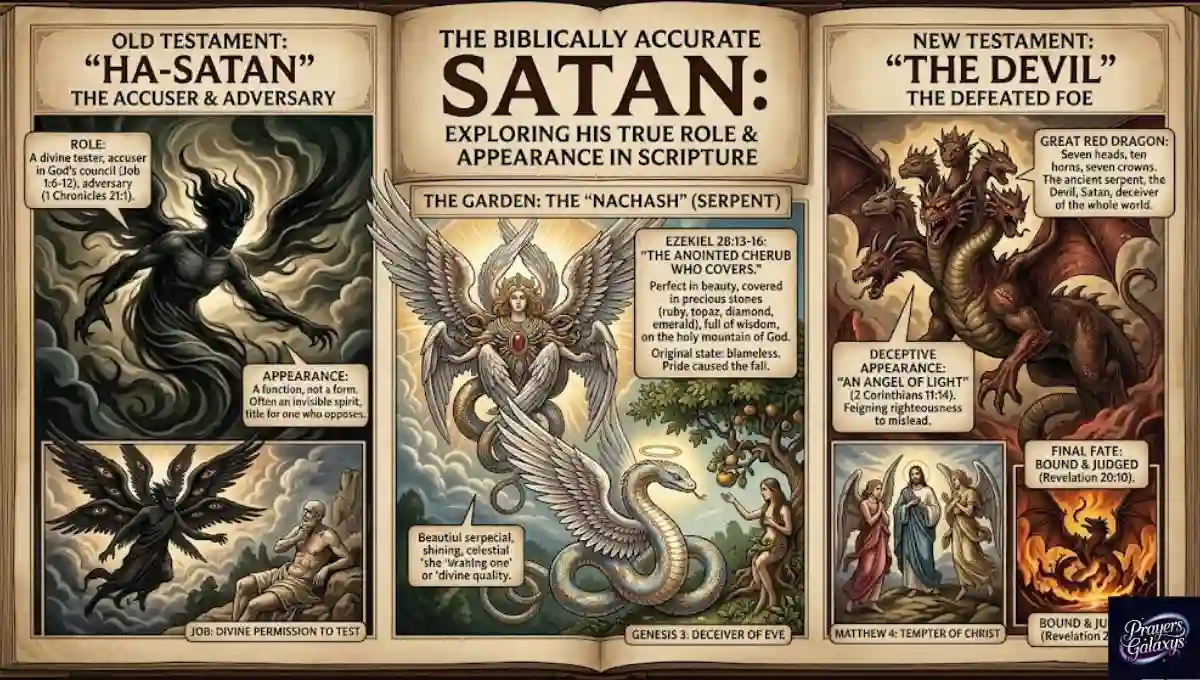
The biblically accurate Satan looks nothing like the red-skinned, horned figure of popular imagination. Satan in the Bible appears as a spiritual adversary, an accuser, and a deceiver operating within boundaries set by divine sovereignty. Biblical Satan is described using titles like “the accuser of the brethren,” “the father of lies,” and “the ancient serpent,” each revealing a different facet of his role.
This article examines who Satan is in the Bible according to Scripture itself, covering Ha-Satan in Hebrew thought, the Lucifer debate, Satan’s role in Job and Revelation, and comparative views from Judaism and Islam. Every section draws on biblical text, theology, and biblical demonology to separate scriptural truth from cultural myth.
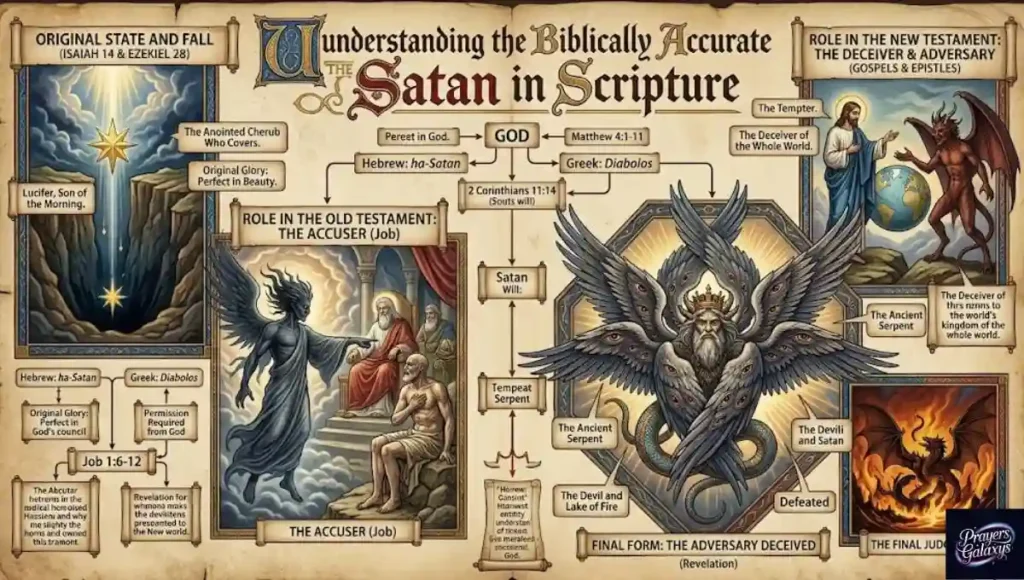
Understanding the Biblically Accurate Satan in Scripture
The Hebrew Concept of Ha-Satan
In the Old Testament, “Ha-Satan” means “the accuser” or “the adversary,” functioning more as a title or role within the heavenly court than a proper name (Job 1:6, Zechariah 3:1).
Satan’s Transformation Across Biblical Texts
- Old Testament: A prosecuting figure in God’s divine council
- Intertestamental writings: Increasingly personified as an evil being
- New Testament: Fully developed as “the devil,” “the dragon,” and “the tempter”
Distinct Roles Across Old and New Testaments
| Testament | Primary Role | Key Passages |
| Old Testament | Accuser in heavenly court | Job 1-2, Zechariah 3 |
| New Testament | Tempter, deceiver, enemy of God | Matthew 4, John 8:44, Revelation 12 |
Characteristics of the Biblically Accurate Satan
Satan’s Functions and Symbolic Significance
Satan’s role in the Bible includes tempting (Matthew 4:1-11), accusing believers (Revelation 12:10), and spreading demonic deception throughout the world (2 Corinthians 11:14).
Biblical Descriptions and Metaphorical Imagery
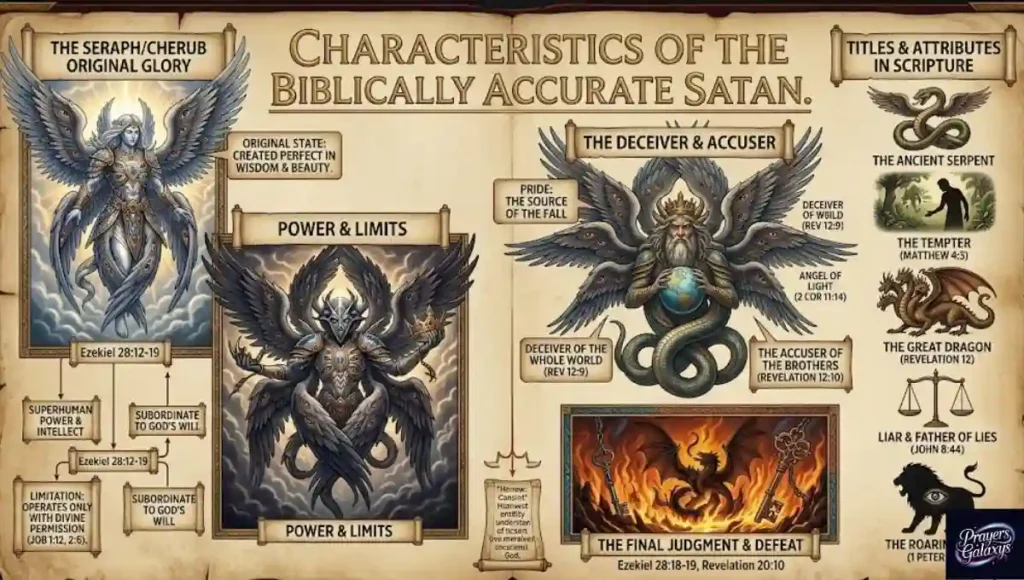
- “Ancient serpent” (Revelation 12:9)
- “Angel of light” disguise (2 Corinthians 11:14)
- “Roaring lion” seeking prey (1 Peter 5:8)
- “Great dragon” in Revelation 12:9
The Adversary’s Operational Boundaries
Scripture consistently shows Satan operating under God’s permission, not independent power. In Job 1:12, Satan cannot act without divine authorization, demonstrating clear divine sovereignty over the spiritual adversary.
Deception as Primary Tactic
Satan’s primary method is deception rather than brute force. John 8:44 calls him “the father of lies,” and his strategy throughout Scripture involves twisting truth rather than direct confrontation.
Biblical Versus Cultural Depictions of Satan
Literary and Artistic Influences on Satan’s Image
Much of the popular image of Satan, horns, hooves, and red skin, comes from medieval art and literature like Dante’s Inferno, not from the biblical text itself.
Historical Development of Visual Representations
Early Christian art rarely depicted Satan with physical form; later medieval and Renaissance artists borrowed imagery from pagan gods (like Pan) to visualize the devil.
Modern Media’s Portrayal of the Adversary
Modern films and television often portray Satan as either a charismatic figure or a cartoonish villain, both diverging sharply from the biblical Satan’s description as a deceptive spiritual being.
Key Differences Between Scripture and Culture
| Aspect | Biblical View | Cultural View |
| Appearance | Spirit being, no fixed form | Red skin, horns, hooves |
| Power | Limited, under God’s sovereignty | Often shown as God’s equal |
| Method | Deception | Physical torment |
| Location | Active on earth | Rules in hell |
The Lucifer Debate: Biblically Accurate Analysis

Etymology and Translation History
“Lucifer” comes from the Latin Vulgate translation of Isaiah 14:12, meaning “morning star” or “shining one,” originally a Hebrew term (helel) describing brightness.
Isaiah 14: Addressing Babylon’s King
Isaiah 14 is primarily addressed to the king of Babylon, using poetic language about a fallen “morning star” to describe his pride and downfall.
Ezekiel 28: The Tyre Connection
Ezekiel 28 similarly addresses the king of Tyre, though some theologians see secondary references to a fallen heavenly being behind the human ruler.
Development of the Satan-Lucifer Association
The connection between Lucifer and Satan developed primarily through later Christian interpretation and translation tradition, rather than explicit textual identification in the original Hebrew.
Jesus’s Statement on Satan’s Origin
In Luke 10:18, Jesus references Satan’s fall “like lightning from heaven,” a key text scholars use when discussing Satan’s angelic origin.
Theological Understanding of the Biblically Accurate Satan
Satan’s Function in Biblical Narratives
Across Scripture, Satan functions as the spiritual enemy who opposes God’s kingdom, tempts humanity toward sin, and ultimately faces final judgment (Revelation 20:10).
Detailed Examination of Key Passages
- Genesis 3: The serpent’s deception of Eve
- Job 1-2: Satan’s challenge before God
- Matthew 4: Satan’s temptation of Jesus
- Revelation 12: War in heaven and Satan’s defeat
Interpretations Across Christian Traditions
Christian traditions broadly agree Satan is a real spiritual adversary, though they differ on details of his origin, current activity, and final fate in the lake of fire.
Comparative Religious Perspectives on the Biblically Accurate Satan
Jewish Understanding of Ha-Satan
In Jewish tradition, Ha-Satan is often understood less as God’s cosmic enemy and more as a heavenly prosecutor or tester within divine sovereignty.
Islamic Conception of Iblis
In Islam, Iblis (often equated with Satan) is a jinn who refused to bow to Adam, sharing the theme of pride-driven rebellion found in Christian tradition.
Cross-Tradition Comparative Analysis
| Tradition | Name | Core Role |
| Judaism | Ha-Satan | Heavenly accuser/tester |
| Christianity | Satan/Devil | Cosmic enemy of God |
| Islam | Iblis | Prideful jinn who rebelled |
Zoroastrian Influence on Development
Some scholars suggest Zoroastrian dualism (good vs. evil deities) influenced later, more cosmic depictions of Satan in intertestamental Jewish thought.
Satan in the Book of Job: Testing, Permission, and Divine Sovereignty
Satan’s Challenge Against Job
Satan challenges God’s assessment of Job’s righteousness, suggesting Job only serves God because of his blessings (Job 1:9-11).
God’s Authority Over Satan
Satan can only act against Job within limits explicitly granted by God, reinforcing the theme of divine sovereignty over the spiritual adversary (Job 1:12, 2:6).
Lessons From Job’s Trials
Job’s story teaches that suffering doesn’t always indicate sin, and that Satan’s accusations ultimately fail under God’s sovereign oversight.
Read More : Biblically Accurate Angels: What the Bible Really Says in 2026
Scholarly Debate: Satan’s Angelic Origin
Traditional Fallen Angel Position
Many theologians hold that Satan is a fallen angel, originally created good but corrupted by pride, based on Isaiah 14, Ezekiel 28, and Revelation 12.
Alternative Created Adversary View
Other scholars argue Satan’s “fall” language is poetic judgment on human kings, and that Satan’s adversarial role doesn’t require a literal angelic rebellion narrative.
Theological Implications of Each Perspective
- Fallen angel view emphasizes cosmic rebellion and ongoing spiritual warfare
- Created adversary view emphasizes Satan’s permitted, limited testing role
Tradition Versus Textual Analysis
Traditional readings often rely on later doctrinal development, while strict textual analysis focuses on what each passage says in its original context.
Practical Applications for Believers
Regardless of origin debates, Scripture calls believers to resist Satan through faith, prayer, and the armor of God (Ephesians 6:11-18, 1 Peter 5:8-9).
Cultural Impact of the Biblically Accurate Satan
Influence on Religious Practices
Belief in Satan shapes practices like deliverance ministry, exorcism in Christianity, and spiritual warfare prayers across many denominations.
Spiritual Warfare Approaches
Spiritual warfare in Christianity often centers on resisting demonic deception through prayer, Scripture, and the “armor of God” described in Ephesians 6.
Contemporary Cultural Manifestations
Satan continues to appear in books, films, and music, often blending biblical themes with invented mythology unrelated to the biblical text.
Psychological Effects of Satan Belief
Belief in a personal spiritual adversary can shape how believers interpret temptation, guilt, and moral struggle within a Christian worldview.
Synthesizing the Biblically Accurate Satan
The biblically accurate Satan emerges as a real but limited spiritual being: an accuser, deceiver, and tempter operating under God’s sovereign permission, not a co-equal “evil god” ruling an independent kingdom of darkness.
Frequently Asked Questions About Biblically Accurate Satan
1. Who is Satan in the Bible?
Satan is a spiritual adversary who accuses, tempts, and deceives under God’s sovereign limits.
2. What does Satan actually look like?
The Bible gives no fixed physical description, only symbolic images like a serpent or dragon.
3. Is Lucifer and Satan the same person?
The Lucifer-Satan connection comes mainly from later translation tradition, not explicit biblical identification.
4. Was Satan an angel before he fell?
Many theologians believe so, based on passages about a heavenly being’s pride and fall.
5. Does Satan rule Hell?
Scripture portrays Satan as active on earth now, with final judgment in the lake of fire still in the future.
6. What did Jesus say about Satan?
Jesus referred to Satan’s fall “like lightning” and identified him as a liar and murderer (John 8:44).
7. How does Satan tempt believers?
Primarily through deception, disguising evil as good, as seen in 2 Corinthians 11:14.
Conclusion
The biblically accurate Satan is far more nuanced than popular culture suggests, a spiritual adversary, accuser, and deceiver whose power remains limited under divine sovereignty. From Ha-Satan in Job to the dragon of Revelation, Scripture consistently portrays Satan in the Bible as real but never equal to God.
Understanding Satan’s role in Scripture, including the Lucifer debate and his ultimate defeat, helps believers approach spiritual warfare with biblical clarity rather than cultural myth. The biblical view of Satan ultimately points toward God’s victory and final judgment over the spiritual adversary.

Welcome to Prayersgalaxys ! I’m Abdul Mannan Haider. Christian Faith Writer | 10+ Years Bible Study Experience | Founder of (prayersgalaxys.com)
Sharing prayers, Daliy Bible Verses and biblical wisdom to strengthen your faith.